
South Korea's Benchmark Index Slips Below Key Milestone
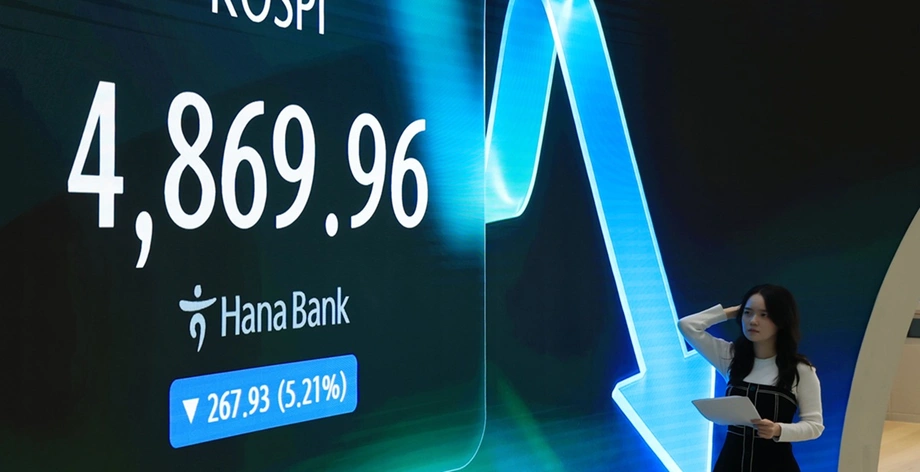
South Korea's benchmark stock index fell below the psychologically important level of 5,000 on November 20, 2026, closing down 267.93 points, or 5.21 percent, at 4,869.96. The drop followed a turbulent week of heavy foreign selling and a broader retreat in technology shares that also erased the total market capitalization of the Kospi below 4,000 trillion won, landing at 3,991.3977 trillion won. This downward movement continues a difficult period for local equities, echoing a market rout seen after last year's attacks on technology share prices when the Kospi suffered steep weekly losses. The broader decline swept through both main and secondary boards, prompting regulatory interventions as automated trading safeguards were triggered across the exchange.
Contenido
- South Korea's Benchmark Index Slips Below Key Milestone
- Wall Street Pressures and Semiconductor Declines
- A Detailed Look at the Weekly Trading Timeline
- Evaluating the Underlying Liquidity and Margin Pressures
- Global Regulatory Headwinds and Semiconductor Policy
- Upcoming Economic Indicators and Market Catalysts
- The Bottom Line
Trading on the main exchange experienced an abrupt halt when a sell sidecar was activated at 11:54 a.m., freezing program-based sell orders for five minutes to calm the market. A similar automatic safeguard was triggered on the smaller Kosdaq index at 1:28 p.m. as selling pressure intensified. The Kosdaq finished the session down 39.13 points, or 5.71 percent, at 645.68. The severe sell-off reflected deep investor anxiety regarding the sustainability of artificial intelligence investments and a shifting global monetary policy landscape, building on downward momentum that had already seen the Kospi break beneath the 5,000 threshold earlier in the month.
Wall Street Pressures and Semiconductor Declines
International market shocks contributed directly to the domestic downturn, as overnight trading sessions in New York saw major indexes retreat sharply under the weight of technology sector corrections. The tech-heavy Nasdaq dropped 2.49 percent, the S&P 500 fell 1.92 percent, and the Dow Jones Industrial Average declined 1.41 percent. These global losses were compounded by uncertainties surrounding artificial intelligence infrastructure funding, regulatory scrutiny over chip exports, and executive leadership questions at key technology firms. The Philadelphia Semiconductor Index fell 5.28 percent during the same trading window, transmitting immediate downward pressure to major South Korean exporters.
Domestic semiconductor leaders bore the brunt of the foreign capital outflow. Samsung Electronics closed at 183,100 won, down 7.01 percent for the day, while SK Hynix fell 5.92 percent to finish at 1,113,000 won. Other large technology and industrial suppliers experienced severe pullbacks, with Samsung Electro-Mechanics dropping 12.54 percent and preferred shares of Samsung Electronics falling 8.38 percent. Analysts noted that the negative sentiment quickly expanded from memory chip manufacturers to related component suppliers, power equipment providers, and finance counters, reversing recent gains that had been supported by strong corporate earnings reports earlier in the autumn, such as the period when SK Hynix record profit figures temporarily propelled the index above the 6,000 mark.
Foreign institutional investors acted as the primary net sellers, offloading large volumes of domestic shares as risk aversion mounted globally. In the main bourse, foreign investors recorded substantial net sales, while institutional participants also reduced their equity exposure. Individual investors stepped in to absorb a significant portion of the offloaded shares, but their net buying was insufficient to counter the broader downward trajectory. Market participants pointed out that the aggressive foreign selling stemmed from structural reallocation away from Asian technology supply chains rather than localized corporate disappointments.
A Detailed Look at the Weekly Trading Timeline
The sequence of trading sessions leading up to the November 20 market drop revealed mounting volatility and persistent downward pressure across the South Korean exchange:
- November 16: The Kospi opened lower and extended losses, closing down 3.59 percent at 5,100.50 as Wall Street technology shares retreated amid leadership uncertainties at leading artificial intelligence firms.
- November 17: The index fell further by 2.59 percent, or 132.02 points, to close at 4,968.48, slipping below the 5,000 milestone for the first time in approximately nine months.
- November 18: Markets attempted a cautious stabilization, though foreign capital continued to exit large capitalization technology counters.
- November 19: Persistent concerns over upcoming macroeconomic data releases and tightening export rules kept secondary and primary boards under tight ranges.
- November 20: Selling accelerated sharply across all sectors, resulting in a 5.21 percent plunge to 4,869.96 and triggering automatic market sidecars on both the Kospi and Kosdaq.
Evaluating the Underlying Liquidity and Margin Pressures
Domestic financial buffers faced noticeable strain as the market correction deepened, with retail investors encountering increased margin calls and forced liquidation risks. Financial authorities had previously extended a temporary exemption on collateral maintenance ratio obligations through January 31, 2027, in an effort to cushion investors against sudden price drops, but the measure provided limited relief against the sharp wave of selling. Credit financing balances contracted visibly through October and November, indicating a steady process of deleveraging as retail participants reduced their borrowed funds to meet margin requirements.
Investor deposits hovered in the 89 trillion won range during early November, showing a reduced capacity for domestic institutional and retail funds to absorb heavy foreign equity unloading. Pension funds and domestic institutional buyers recorded relatively modest net purchases that failed to match the scale of overseas capital outflows. This liquidity imbalance highlighted the heavy reliance of the domestic capital market on foreign portfolio flows, particularly within the semiconductor and high-bandwidth memory sectors that drive a substantial share of total market capitalization.
Global Regulatory Headwinds and Semiconductor Policy
International trade policies and regulatory actions added further complexity to the investment environment, particularly regarding advanced semiconductor supply chains. Regulatory developments in the United States, including proposed rules to restrict remote access to advanced artificial intelligence chips by foreign entities through third-party data centers, created fresh compliance questions for hardware manufacturers. Market analysts noted that heightened scrutiny over export compliance and trade restrictions tended to amplify risk aversion among foreign portfolio managers holding Korean technology assets.
Concerns regarding the actual return on investment for massive data center projects also influenced market sentiment, paralleling debates seen earlier in the year when questions surrounding OpenAI revenue figures temporarily unsettled semiconductor valuations. While memory producers continued to benefit from strong demand for specialized components required by generative artificial intelligence systems, investors began demanding clearer evidence of end-user profitability before committing additional capital to upstream suppliers and equipment manufacturers.
Upcoming Economic Indicators and Market Catalysts
Market participants are now closely monitoring key domestic and international calendar events that could dictate the direction of equity prices in the coming weeks. The United States Department of Commerce is scheduled to release the personal consumption expenditures price index, a vital gauge watched closely by policymakers for inflation trends and interest rate guidance. Domestically, the Bank of Korea is set to convene its monetary policy committee to deliberate on benchmark interest rates and economic growth forecasts.
Analysts suggest that any moderation in global inflation figures or stabilizing signals from foreign currency markets could help reduce bond yield pressures and encourage a gradual return of foreign capital. However, until foreign selling pressure subsides and large capitalization chip stocks establish a firm technical base, the domestic market is expected to experience heightened sensitivity to external technology sector movements and macroeconomic data releases.
The Bottom Line
- The Kospi declined 5.21 percent on November 20, 2026, closing at 4,869.96 and dropping below the 5,000 threshold.
- Total market capitalization fell below 4,000 trillion won for the first time in months, reaching 3,991.3977 trillion won.
- Automatic sell sidecars were triggered on both the Kospi and Kosdaq indexes during the trading session.
- Heavy foreign capital outflows and continued weakness in major semiconductor counters like Samsung Electronics and SK Hynix drove the market losses.
- Upcoming economic releases, including United States inflation data and a Bank of Korea policy meeting, remain central to the near-term market outlook.